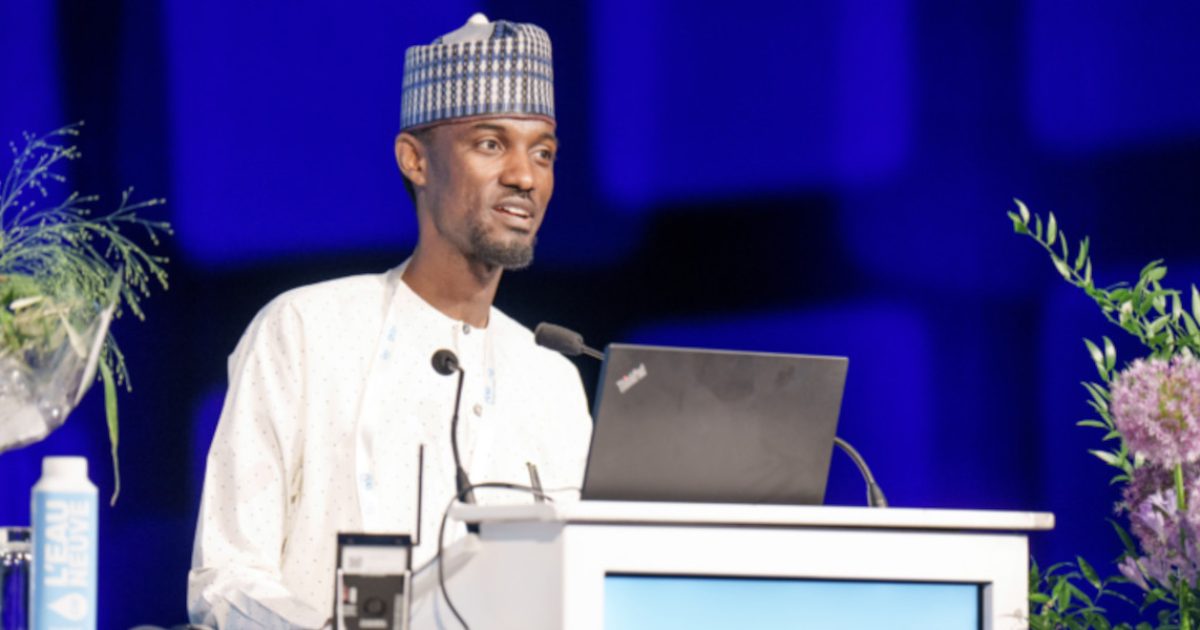
Mahmoud Maïna, neuroscientist specializing in Alzheimer’s Disease, received an award to develop a laboratory in Nigeria.
“We are working on something very transformative: establishing an open-access stem cell biobank in Nigeria to answer questions on population-specific differences to diseases,” he declared to News Tank on 04/06/2025.The Wellcome Trust Fund Career and Development Award he received will allow him to establish a stem cell biobank of Alzheimer’s patients of African ancestry in Yobe State.
This new phase in Maïna’s career is filled with economic, academic, and security challenges. He explains to News Tank the reasons behind his move and his goals for this new research project. “During my post-doctoral research in the UK, I realised that the models we used to study the disease were mostly composed of patients of European background”, he states. Mahmoud Maïna emphasises that “less than 2% of genetic studies include Africans”.
According to him, the main challenge in establishing his project in Nigeria is “to prove and demonstrate that we can do world-class research in low-resource regions.” He will also face challenges related to recruitment and the electricity supply. “Also, if we order something for a lab in Europe, it can arrive in two or three days, but in Nigeria, we have to plan ahead, as it could take a month or two.” Finally, he intends to create an academic ecosystem, “which will make people want to go there for research and inspiration.”
“It would have been easier to undertake this research in the UK”
You recently received a Wellcome Fund Trust Career and Development Award, what is it
about?
This award is around £2.9 M (€3.44 M) for up to eight years. It allows scientists to really focus on their work and to have the stability required to answer big questions. It is really prestigious, and the whole idea behind this award is for me to expand my research on Alzheimer’s disease. But this time around, we are working on something very transformative: establishing an open-access stem cell biobank in Nigeria to answer questions on population-specific differences to diseases.
What is the purpose of this project?
When I started my master’s in the UK, I started working on Alzheimer’s disease on the cellular and molecular level. I did my PhD and post-doctoral research in the same area. But during my post-doctoral research, I started working on induced pluripotent stem cells. It led me to realise that the models we used to study the disease were mostly made up of patients of European background. However, there are differences in the risks of Alzheimer’s andother diseases due to genetics and environment. To give you an example, there is a genetic risk factor called APOE, which comes in three major types: APOE2, APOE3 and APOE4. People who have the APOE4 variant have a higher risk of developing Alzheimer’s disease. The increase in risk is greater if they are of Japanese or European descent; however, if they are of African background, the risk is reduced.
What are the reasons for this difference?
We still do not understand it all, because there are only a few studies on Alzheimer’s patients from Africa. So when I started working on the stem cell models, I thought we needed more models that are reflective of the African genetic background to fully understand the differences and their role in disease development. Therefore, around that time, I started working on developing stem cell models from indigenous Nigerians. I went back to Nigeria, spent a few
months collecting tissue in collaboration with clinicians. And I produced the first stem cell model from indigenous Nigerians. We can now begin to look at the changes that may be driven by genetic background between Africans and others, using the model that we can grow in the lab, in a dish.
Have patients of African background been underrepresented in brain pathology research?
Not just brain pathologies. Africa has the highest genetic diversity of all continents, which means that the difference between one African and another could be larger than the genetic difference between a Japanese person and a European. But unfortunately, less than 2% of genetic studies include Africans, and for dementia related studies, I would say it is less than 1%. Given the genetic diversity of the continent, we should be seeing huge amounts of research, but we are not.
From Europe, this research project and your relocationto Nigeria seem very challenging. Do you see it as such,or do you think it is a normal evolution of your career?
I do not see it as a normal evolution. I think it is going to be a challenging one. But I think that throughout my career, I have already gone through a lot of hardship, and I believe that challenges will continue to arise, and I will face them. It would have been easier to undertake this research in the UK, but I would not have as much impact as I would in Nigeria, since Nigerians will see that I left my comfort zone and everything I created in England and came back to try and build this system at home. However, the plan at the moment is that I will keep an adjunct group leader position in my current workplace in the UK, at the University of Sussex. This means that I will still have an office and can still do research there, and that my team from Nigeria can also benefit from the resources there.
What are the main challenges in front of you with this project?
The main and broader one will be to prove and demonstrate that we can do world-class research in low-resource regions. But there are some other obstacles. First, challenges in recruitment, both due to a lack of critical skills from locals, that you then have to train up, and to security, as Yobe State has suffered from Boko Haram and Islamic State attacks in the past. Even though it is not as bad as people portray it, if you want collaborators to come, you have to reassure them. Next, there is the issue of electricity, even though in our research centre we have solar panels and generators. Also, if we order something for a lab in Europe, it can arrive in two or three days, but in Nigeria, we have to plan ahead, as it could take a month or two. Finally, there is an academic ecosystem issue. In England, the ecosystem is robust. There can be several in-person seminars on neuroscience in our department at the University of Sussex. However, in Nigeria, only a handful of people work on the topic, and such initiatives are not common. We will thus have to create that ecosystem in our centre, which will make people want to go there for research and inspiration.
Is the academic situation in Nigeria, and more specifically in Yobe State, favourable to
scientific projects like yours?
Yes. I am happy that the Yobe state government is very supportive. They have supported me in establishing the Biomedical Science Research and Training Centre at Yobe State University. They have recently completed building a permanent site for the institute I am leading. They take care of the logistics for our collaborators when they arrive, the accommodation, security… The governor of Yobe State, Mai Mala Buni, is open-minded, and if you come with ideas that he thinks are beneficial, he will support them. This is actually how all of it started. He buys the idea that by supporting science, you are going to build up the next generation, and you’re going to make Yobe more attractive for outsiders. He believes that this will allow Yobe State to attract top-tier talent to build local capacity and drive technological innovation.
What do you wish to achieve through this project, scientifically, academically and personally?
On the scientific front, I hope to produce models that will allow us to understand Alzheimer’s disease in the African population and how ancestry is shaping the development of the disease, which is very crucial if we want to produce equitable diagnostics and therapeutic approaches for this type of disease. Academically, I aim to build an ecosystem around this centre where we have many scientists who have the passion and drive to apply and work towards getting big grants, similar, or even better than mine, to do their research there, so that eight years down the line, we have a community that is very competitive on an international level. I want to continue my work and develop into a world leader in this area of study, but run this endeavour locally, in Nigeria.
This article produced by Afriscitech was published by NewsTank Education & Research on July 5, 2025. It is reproduced with the kind permission of NewsTank.