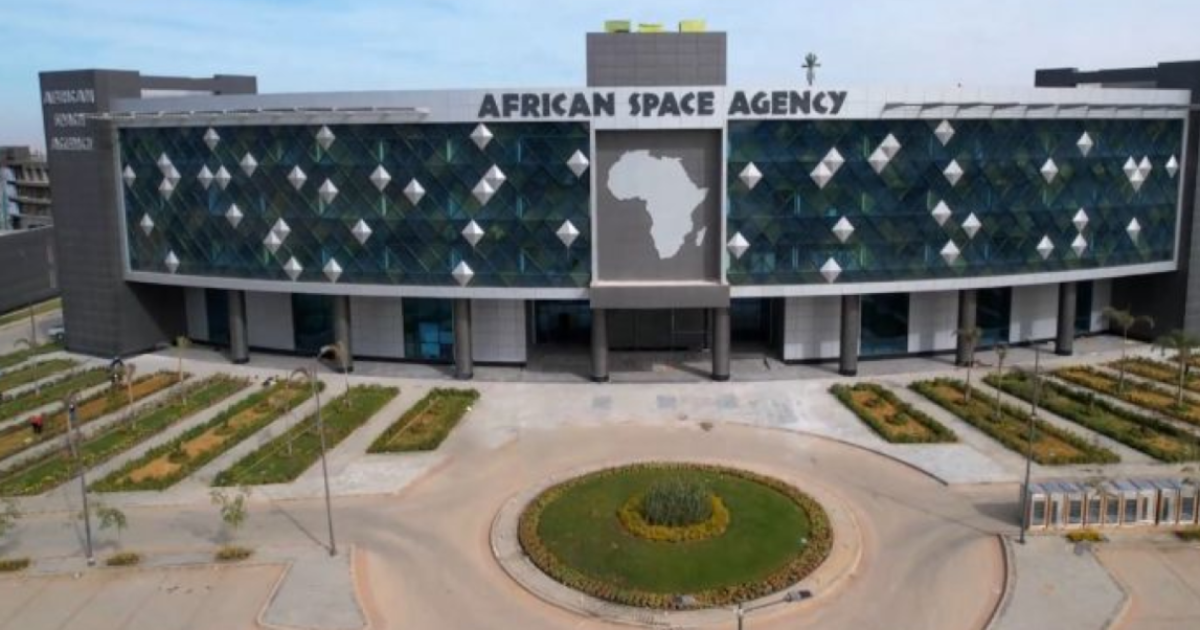
The African Space Agency (ASAf) inaugurated its new headquarters in Cairo on April 20, 2025.
“This step represents an important milestone in Africa’s joint action,” declared Egyptian Foreign Minister Badr Abdelatty, speaking to the Turkish news agency Anadolu. Numerous African ministers, heads of national space agencies, and representatives from NASA, the European Space Agency, and the Japan Aerospace Exploration Agency (JAXA) were present for the occasion.
Egypt was chosen as the host country for the agency by the African Union Executive Council in 2019, a year after the adoption of ASAF’s statutes. The agency itself was officially established in January 2023, following an agreement between the African Union and Egypt on funding for its headquarters. The inauguration of this new headquarters is another step forward for ASAF in its goal of coordinating space technology efforts across the continent.
“State agencies operate on a national scale. With the African Space Agency, there is an opportunity to establish cooperation on a continental scale, in the same way as with the European Space Agency,” says David Baratoux, a geologist and planetary scientist at the IRD (French Research Institute for Development), who works closely with the Senegalese Space Agency.
Regarding the choice of Cairo, in addition to the agreement between Egypt and the African Union, “Egypt is already more advanced than other African countries in the space sector”, notes David Baratoux at the Africa desk of News Tank.
The african space economy is developping
The African space economy is developing, with the formation of numerous national agencies in countries that previously lacked them. “These agencies are tools for gaining a national perspective on what the national industry wants to develop in terms of space applications,” explains David Baratoux.
Here, there’s no talk of an African lunar or Martian mission in the short term: “The most common activities involve the manufacture of nanosatellites for Earth observation, both for research and for applications of societal interest,” he concludes.
Space Agencies in Africa
21 of the 55 member states of the African Union have an organization responsible for space policy. For some, this is a dedicated space agency, for others, services existing within the ministry of higher education and research or a university are responsible for monitoring and developing a space policy.
- South Africa : South African National Space Agency
- Algeria: Algerian Space Agency
- Angola: National Space Programme Management Office
- Botswana: The Botswana International University of Science & Technology
- Côte d’Ivoire: Centre for Geographic and Digital Information
- Djibouti: Ministry of Higher Education and Research of Djibouti
- Egypt: Egyptian Space Agency
- Ethiopia: Ethiopian Institute of Space Science and Technology
- Gabon: Gabonese Agency for Space Studies and Observations
- Ghana: Ghana Centre for Space Science and Technology
- Mauritius: Mauritius Research and Innovation Council
- Kenya: Kenya Space Agency
- Libya: Libyan Centre for Remote Sensing and Space Science
- Morocco: Royal Centre for Remote Sensing
- Namibia: Space Science Council, National Commission for Scientific and Technological Research
- Nigeria: National Agency for Space Research and Development
- Rwanda: Rwanda Space Agency
- Senegal: Senegalese Agency for Space Studies
- Sudan: National Remote Sensing Center
- Tunisia: National Center for Mapping and Remote Sensing
- Zimbabwe: Zimbabwe National Geospatial and Space Agency
This article, produced by Afriscitech, was published by NewsTank Education & Research on May 15, 2025. It is reproduced with the kind permission of NewsTank, and has been translated into English by Afriscitech.