How can a country simultaneously lack jobs for its young people and skills for its businesses?
That is the question I am certain Nicole Sulu will ask me at the 12th edition of the Makutano Forum, scheduled for next November. It is precisely the question that my team and I have been grappling with since January. Let me explain.
The Missing Milestone
Since June 2024, we have strengthened the framework of the Ministry of National Education and New Citizenship to better guide the transformation of our education system. The 2024–2029 Five-Year Plan established the framework for our action. Other instruments have complemented it, notably strategies related to school feeding and education in emergency situations, policies for the continuing professional development of primary and secondary school teachers, the Curriculum Guidance Framework (COC), the National Policy on Information and Communication Technologies for Education and Training, as well as the Kinshasa Declaration on the Sustainable Financing of Education and Training.
However, one essential building block was still missing from this framework: the National Strategy for Technical and Vocational Education (TVE).
Projects That Call for New Skills
Why? Because several transformative projects, championed by the Head of State and now a priority for the Government, will profoundly transform our country’s skills needs. The Kivu-Kinshasa Green Corridor will balance ecosystem protection with agricultural development and, more broadly, the growth of a green economy. The Lobito Corridor will further connect our mining basins to regional and international markets, while promoting logistics, local processing, and employment. As for the Inga 3 development program, supported by the World Bank, it is laying the technical, institutional, and social groundwork for a major energy project, with investments in infrastructure, services, skills, and employment in Kongo Central.
However, these projects will only realize their full potential if we begin training, from now on, the technicians, mid-level managers, operators, and entrepreneurs they will need.
Two Complementary Pathways
Here, we must distinguish—without pitting them against one another—between technical and vocational education (TVE) and vocational training. TVE is primarily part of the formal school system: it trains young people over several years, combines general and practical instruction, leads to a state-recognized diploma, and prepares students both for a career and for pursuing higher education. Vocational training is more flexible and more directly geared toward employment: it offers, in particular, short-term or modular courses, apprenticeships, advanced training, and retraining, for both young people and adults.
To support these transformative initiatives, these two pathways must work in tandem. TVE will gradually build a sustainable pool of qualified technicians, while vocational training will make it possible to respond more quickly to the immediate needs of businesses, upskill workers already on the job, and prepare those who need to acquire a new qualification. One builds skills over the long term (TVE); the other allows for faster adaptation to changes in the labor market (vocational training).
Starting from the Ground Up
So, we chose not to begin by drafting a strategy from Kinshasa. The first substantive step outlined in our roadmap was to face reality head-on: to observe the institutions, listen to teachers and learners, meet with businesses, and compare existing training programs with the actual needs of the regions. This assessment was intended to serve as the factual foundation for the strategy before it was drafted.
Nine missions were thus deployed to nine cities across eight provinces, focusing on five major economic hubs:
- construction and the manufacturing industry in Kinshasa;
- logistics and transportation in Kongo Central;
- the mining industry in Haut-Katanga and Lualaba;
- agriculture in Kwilu, Kasai, and Kasai Oriental;
- fisheries and forestry in Tshopo.
This study does not claim to exhaustively cover the diversity of the twenty-six provinces on its own, but the convergence of findings gathered in very different economic contexts is strong enough to compel us to act.
What the Assessment Teaches Us
The first lesson is the most fundamental: our challenge lies not only in the number of training programs, but in their relevance. In several of the regions assessed, traditional training programs continue to be organized out of habit and convenience, even as local economies evolve and demand different skills. In mining regions, for example, needs are concentrated in heavy equipment operation, safety, and digital technologies. In Kongo Central, the deep-water port of Banana is creating demand in logistics, construction, and hospitality. In Tshopo, river transport and industrial maintenance must play a more significant role.
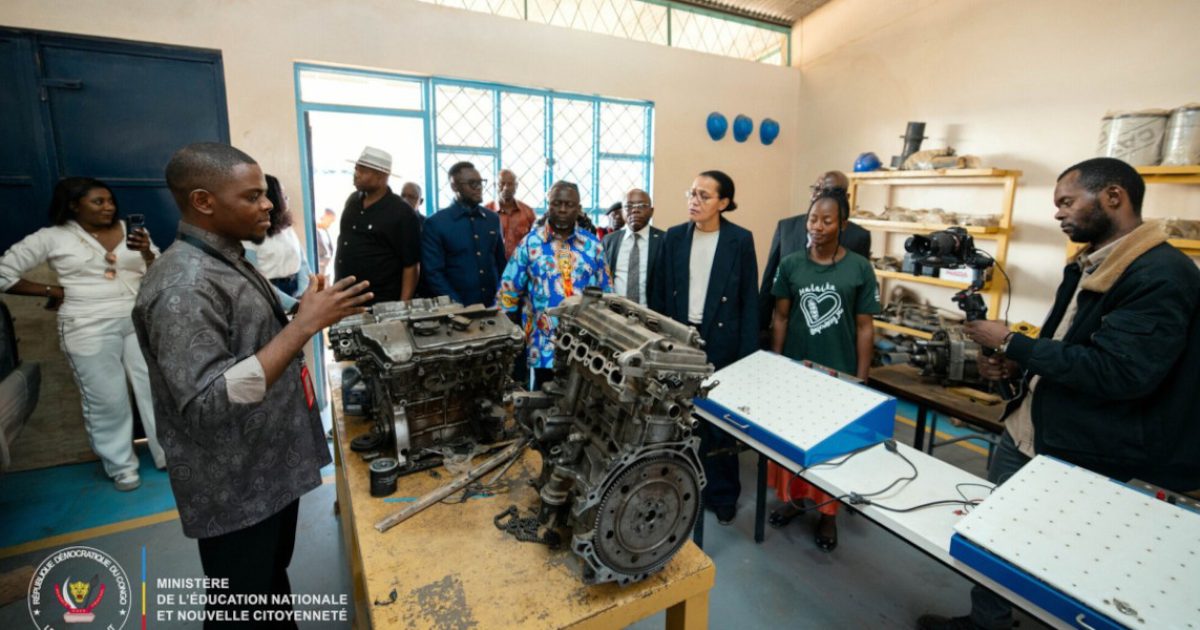
The second lesson is that a training programs does not become technical simply because you add the word! In several of the institutions we visited, the workshops are in poor condition, the equipment is inadequate or unusable, and practical exercises end up becoming theoretical demonstrations. At the same time, the subsector lacks teachers who are sufficiently specialized and regularly trained in new technologies. We must therefore work together to address curricula, equipment, and teacher competencies: modernizing one without the other two would not produce the expected results.
The third key finding concerns the transition from training to employment. Internships do exist, but they are too often informal and inadequately supervised. In Kongo Central, for example, nearly 97% of schools report sending their students on internships, while only 3% have formal agreements with host organizations. We also provide training without sufficiently tracking what becomes of graduates, even though their successful entry into the workforce should be one of the primary indicators of a program’s relevance.
Rethinking the Relevance of Educational Programs
We must no longer sustain a program simply because it exists, but because it effectively prepares young people to enter the workforce, start a business, or pursue technical studies.
This does not mean closing training programs indiscriminately. It means evaluating them, province by province, in terms of the skills they impart, the quality of hands-on learning, the employment or entrepreneurial opportunities they open up, and the economic needs of the region.
Some will need to be strengthened and modernized; others will need to evolve, be consolidated, or gradually give way to training programs more relevant to the region.
The future strategy must therefore align the map of training programs more closely with that of economic regions. But it must not reduce education to the immediate needs of businesses alone. Vocational education and training must also impart solid, cross-disciplinary, and transferable skills, and prepare students for self-employment, business creation, local innovation, and further higher education. Only then will it become a true pathway to choice and national transformation.
The answer lies in alignment
The answer to the question posed at the beginning of this article is becoming clearer. Youth unemployment and the skills shortage can coexist when the training offerings, facilities, teaching practices, and partnerships with businesses evolve more slowly than the economy. It is a matter of the relevance of the programs, the quality of hands-on learning, and the effective transition from training to employment.
Moving from Strategy to Action
Our ambition is to transform technical and vocational education from a default choice into a path to excellence, autonomy, and national transformation. Each economic region must gradually be matched with a corresponding skills pool. Each program must offer real prospects for certification, employment, entrepreneurship, or further education. Only then will the Republic’s major projects also become major opportunities for Congolese youth.
The National TVE Strategy is expected to be finalized in November 2026. Its publication will not mark the end of the process. It will usher in the most demanding phase: that of funding, implementation, monitoring results, and making necessary adjustments. In reality, the real work will begin then.
We are the Ministry of National Education; we are preparing our children’s future; we are building the nation.
Raissa Malu, Minister of State, Minister of National Education and New Citizenship, Democratic Republic of the Congo
This post has first been published in French on LinkedIn. It has been translated in English by Afriscitech.